1. Different Manufacturers
HDMI is dominated by TV manufacturers, while DP is developed by a consortium of PC and chip manufacturers. Note that HDMI requires a licensing fee, whereas DP does not.
2. Version Evolution
The HDMI interface can transmit audio and video signals at the same time. The differences between versions are as follows:
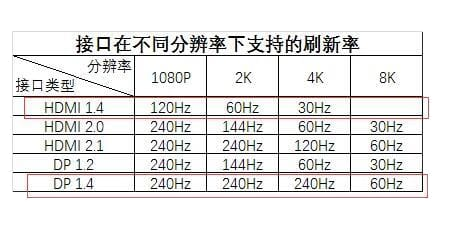
- HDMI 1.4 has a maximum bandwidth of 10.2 Gbps, theoretically supporting 1080P 144Hz, 2K 75Hz, 3840x2160/30Hz and 4096x2160/24Hz.
- HDMI 2.0 has a maximum bandwidth of 18 Gbps and supports 1080P 240Hz, 2K 144Hz, 4K 60Hz and 5K 30Hz.
- HDMI 2.1 has a maximum bandwidth of 48 Gbps and supports 2K 240Hz, 4K 144Hz, 5K 60Hz and 8K 30Hz.
For the DP interface:
- The first generation of DP reached 10.8 Gbps of bandwidth.
- DP 1.2 bandwidth reaches up to 21.6 Gbit/s.
- DP 1.4 bandwidth reaches 32.4 Gbps and adds DSC (Display Stream Compression) technology, supporting 240Hz at 4K and 60Hz at 8K.
3. Widespread Range
HDMI interface: At present, smart TVs and their auxiliary equipment (set-top boxes, game consoles, notebooks, digital cameras, etc.) are almost all equipped with HDMI, making it very widely used. In addition, the mainstream PS4 and Xbox game consoles use the HDMI interface.
DP connection: Mainly popular in the PC field. In addition, AMD's Eyefinity multi-screen splicing technology requires the DP interface.