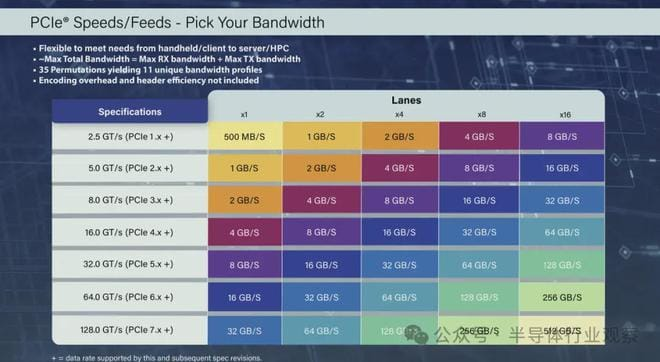
With the continuous advancement of technology, we have ushered in the era of the PCIe 7.0 standard. This new standard makes a qualitative leap in transmission speed, with an x16 bidirectional transmission capacity as high as 512 GB/s. However, for the vast consumer market, the performance of PCIe 4.0 is more than enough—PCIe 7.0 is used more in high-end fields such as quantum computing, hyperscale data centers and cloud applications.
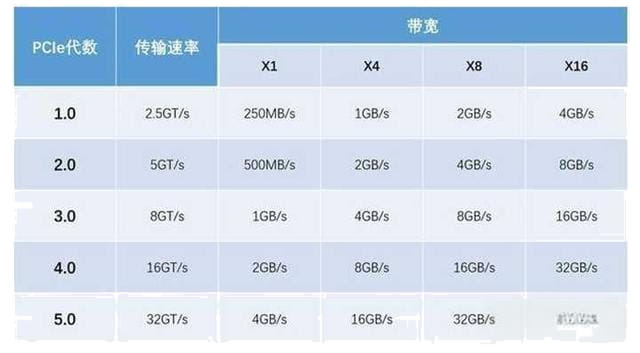
Looking back at the development history of PCIe, from PCIe 1.0 in 2003 to PCIe 4.0 in 2016, each update has brought about a doubling of bandwidth. Taking PCIe 3.0 and PCIe 4.0 as an example, we can intuitively see the significant speed difference: the theoretical speed limit of PCIe 3.0 x4 is 3938.4 MB/s, while PCIe 4.0 x4 soars to 7.88 GB/s, equivalent to 7500 MB/s. This is undoubtedly a big leap in solid-state drive performance. Although PCIe 4.0 comes in entry-level, mid-range and high-end models, even an entry-level PCIe 4.0 SSD performs comparably to a flagship PCIe 3.0 drive.
PCIe 4.0 SSDs have many advantages over PCIe 3.0, such as M.2 interface compatibility, double the sequential read and write speed, faster 4K random read and write, and longer service life. Although in daily use users may not clearly perceive the improvement of PCIe 4.0 over PCIe 3.0, compared with traditional SATA-interface SSDs the speed improvement is a world of difference—especially in the gaming experience.
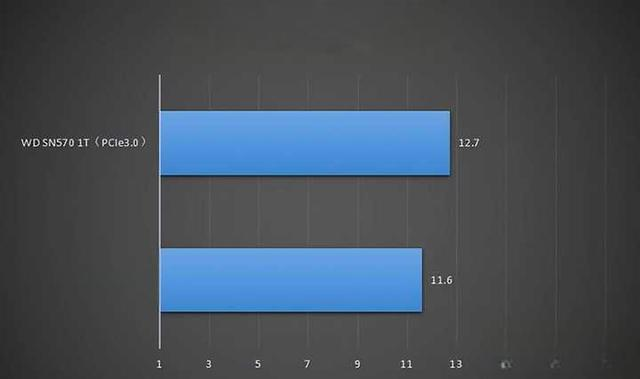
In terms of game loading speed, both PCIe 3.0 and PCIe 4.0 SSDs are significantly faster than SATA SSDs. However, users can hardly perceive the obvious difference between PCIe 3.0 and PCIe 4.0. Therefore, for gamers, whether they choose a PCIe 3.0 or PCIe 4.0 SSD, they can get a satisfactory experience.