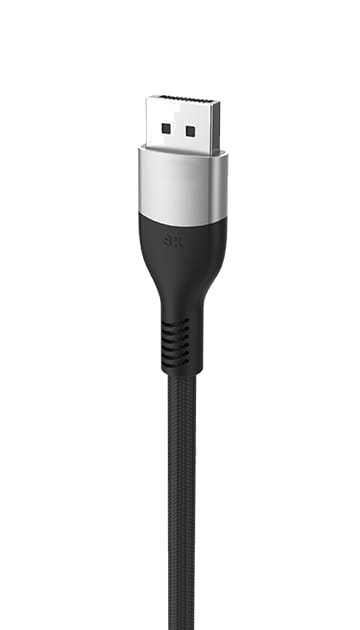
DisplayPort is a digital video interface standard promoted by the Video Electronics Standards Association (VESA), scheduled for May 2006. It is a new digital audio/video interface designed to connect a computer to a screen, or a computer to a home theater system, with no certification and no licensing fees. It is intended to replace the older VGA, DVI and FPD-Link (LVDS) video transfer interface technologies.
DisplayPort was the first display interface to rely on the packet-based data transfer technology found in Ethernet, USB and PCI Express. It can be used for both internal and external display connections. Unlike past standards, which required the clock signal to be transmitted in a fixed differential pair at each outlet, the DisplayPort protocol is based on small packets called micro-packets that can embed the clock signal in the data stream. The advantage is that higher resolution can be achieved with fewer pins. The use of packets also makes DisplayPort extensible, meaning the physical interface itself can gain additional functionality over time without significant changes.
DisplayPort can transmit audio and video at the same time, and each can be transmitted separately without the other. Each color channel in the video signal path can have 6 to 16 bits, and the audio path can have up to 8 channels of 24-bit, 192 kHz uncompressed PCM audio, or compressed audio formats encapsulated in the audio stream. A bi-directional, half-duplex auxiliary channel carries device management and control data for the main link, such as the VESA EDID, MCCS and DPMS standards. In addition, the interface can deliver bidirectional USB signals.
DisplayPort signals are not compatible with DVI or HDMI. However, dual-mode DisplayPorts are designed to transmit single-link DVI or HDMI 1.2/1.4 protocols over the interface, requiring an external passive adapter to select the desired signal and convert the electrical signal from LVDS to TMDS. Dual-mode DisplayPorts with passive adapters do not support VGA or dual-link DVI; these require active adapters to convert the desired output protocols and signals. VGA adapters can be powered using the DisplayPort connector, while dual-link DVI adapters may rely on an external power supply.
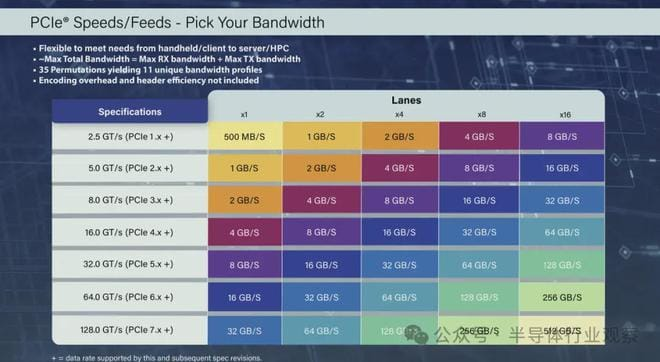
The DisplayPort connector can have 1, 2 or 4 lanes of differential data pairs on the main link. Each lane can have a raw bit rate of 1.62, 2.7 or 5.4 Gbit/s, based on the clock running at 162, 270 or 540 MHz. The data is 8B/10B encoded, meaning every 8 bits of information is encoded in a 10-bit symbol. Thus the effective data transfer rate per lane after decoding is 1.296, 2.16 or 4.32 Gbit/s (80% of the total).